
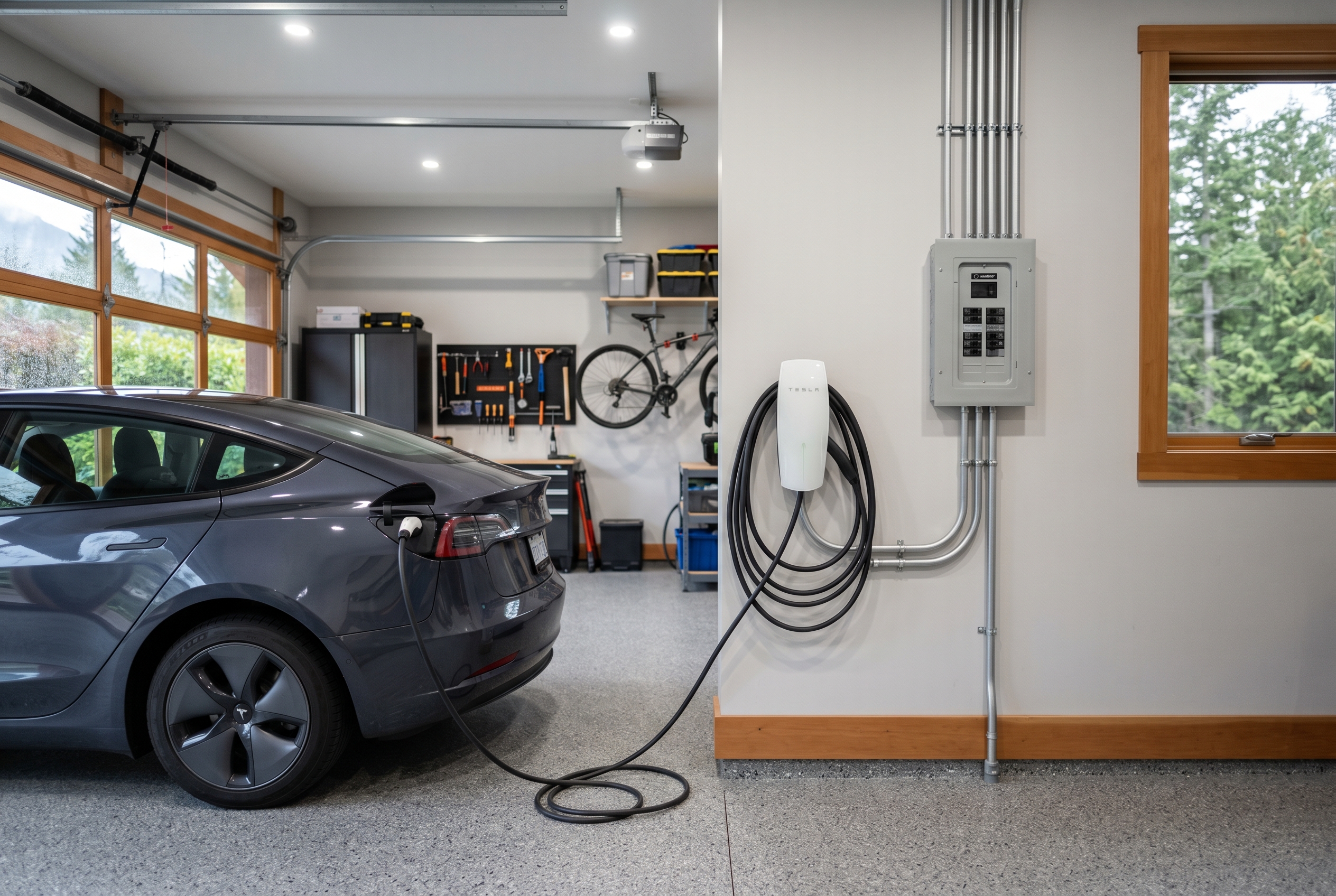
How Much Does Level 2 EV Charger Installation Cost in the Fraser Valley?
The Short Answer
For many Fraser Valley homeowners, a straightforward Level 2 EV charger installation lands somewhere around $1,500 to $3,500. That is a planning range for a fairly normal Abbotsford or Chilliwack house, a standard charger, and no major electrical surprises.
That said, some installs come in lower, and some climb fast. If the charger is going right beside the panel in an attached garage, the cost is usually lower. If the panel is full, the service is undersized, or the charger is going in a detached garage with a long wire run, the number can increase. That is true whether you are in a newer Abbotsford subdivision, an older Chilliwack home, or a rural Fraser Valley property.
This is the part a lot of homeowners in Abbotsford, Chilliwack, and the wider Fraser Valley are trying to figure out before they buy a charger or apply for rebates. Not whether Level 2 charging is worth it. It usually is. The real question is what the install is actually going to cost at your house. If you are weighing charger options check out our pages for EV charger installation in Abbotsford and EV charger installation in Chilliwack.
Here is how to think about it.
What You Are Actually Paying For
When people hear “EV charger installation,” they often picture one job. In reality, there are two separate buckets:
The charger itself
The electrical installation
The charger is the hardware. The installation is the labour, permit, materials, breaker space, wire, mounting, and testing required to make it work safely.
In many cases, the electrical work costs as much as the charger, or more. That is not padding. It is just how 240-volt work goes when it's done properly and under permit.
Typical Charger Hardware Cost
Most Level 2 chargers for home use fall into the $500 to $900 range. There are lower-end units and there are premium smart chargers that cost more, but that middle band is where a lot of homeowners land.
If you already bought a charger, great. That gives you a clearer starting point. If not, it helps to know that the charger price is only part of the project. A homeowner who buys a $550 charger can still end up with a $2,000 total install. A homeowner who buys an $850 charger might still have a relatively clean overall project if the electrical side is simple.
That is why it is better to budget the whole job instead of focusing too hard on the unit itself.
Typical Installation Cost
For a straightforward install, the electrical side often falls in the $700 to $1,900 range. That usually includes:
a site check
permit and inspection coordination
new 240-volt circuit
breaker and wiring
mounting the charger
testing and final commissioning
The reason the range is so wide is simple. No two houses are wired the same, and no two charger locations are equally easy to reach.
What Changes the Price
1. Distance from the panel to the charger
This is one of the biggest cost drivers. If your electrical panel is in the garage and the charger is going a few feet away, the labour and material cost stays relatively controlled. If the panel is in the basement on the opposite side of the house, that is a different job.
Longer wire runs mean more labour, more material, and often more drywall or routing complexity. Copper is not cheap. Neither is the time required to run it cleanly.
2. Attached garage vs detached garage
A detached garage can push the price up quickly. The wire run is longer, the route is often more complicated, and sometimes trenching or additional protection is needed depending on the setup.
This does not mean it is a bad idea. It just means detached garage installs are rarely the cheapest version of the project.
3. Available panel space
A Level 2 charger needs a dedicated 240-volt circuit. If your panel has open capacity and physical space for the breaker, that is good news. If it is packed, you may need a load management solution, a subpanel, or a larger upgrade discussion.
This is where the cost gap between one house and the next gets real. Two neighbours can buy the same charger and get completely different quotes because one panel is ready and the other one is maxed out.
4. Service size and overall electrical capacity
Some homes can physically fit the breaker but still should not add another large load without checking the full electrical demand. Older 100-amp services are where this comes up a lot. Not every 100-amp house needs an upgrade, but plenty do once you add EV charging on top of everything else.
If your home needs a panel or service upgrade before the charger can go in, the project becomes a larger electrical upgrade. That is where pricing can jump. In those cases, it helps to understand the scope of a proper panel upgrade or replacement before you lock in your charger budget. Taurus has local guidance for both panel upgrades in Abbotsford and panel upgrades in Chilliwack.
5. Permit requirements
In BC, a new dedicated Level 2 charging circuit normally needs an electrical permit and inspection. Technical Safety BC explains that permits help confirm regulated work is done safely. That matters for safety, insurance, and resale. Permit costs are not usually the biggest number on the quote, but they are part of the total and should be included in any honest estimate.
If a quote seems suspiciously cheap, one of the first questions to ask is whether permitting and inspection are actually included.
6. Charger mounting and site conditions
Wall type, mounting height, indoor vs outdoor placement, and cable routing all affect the final number. Outdoor installs can still be straightforward, but exposure, weather protection, and routing details matter.
Sometimes the charger location that looks best at first is not the most cost-effective one. A small location change can save a surprising amount on labour and wire.
Realistic Cost Scenarios
Here is a practical way to think about the range. These are planning examples, not fixed prices. The final number still needs a site-based quote.
Scenario 1: Simple attached garage install
Charger: $550
Electrical install: $650 to $900
Total: $1,200 to $1,450
This is the cleaner version of the job. Panel is nearby, capacity is available, and the charger location is easy to reach.
Scenario 2: Typical home install
Charger: $650 to $800
Electrical install: $900 to $1,500
Total: $1,550 to $2,300
This is where a lot of homeowners land. Nothing is wildly difficult, but it is not the absolute easiest install either.
Scenario 3: Longer run or detached garage
Charger: $650 to $900
Electrical install: $1,500 to $2,400
Total: $2,150 to $3,300
This is common when the charger location is farther away or the garage setup adds complexity.
Scenario 4: Panel or service upgrade required
Charger: $650 to $900
EV install work: $900 to $1,500
Panel or service upgrade: $2,000 to $4,000+
Total: $3,550 to $6,400+
This is the expensive version. It is not the norm for every house, but it is absolutely real for some older homes.
How BC Rebates Change the Math
If you qualify for a home EV charger rebate, it can help, but do not build your whole budget around an old rebate number. Program amounts, eligibility rules, approved charger lists, and application steps can change. BC Hydro keeps the current details here: EV charger rebates in BC.
The rebate can reduce your out-of-pocket cost. It does not make a difficult install cheap, and it does not erase the cost of limited panel capacity or a long run to a detached garage.
In other words, rebates are useful. They are not the main price driver. The electrical conditions in your home matter more.
If your install is straightforward, a rebate can make the final bill easier to absorb. If your home needs a service upgrade and the project is several thousand dollars, the rebate still helps, but it is not the thing deciding the budget.
What About Ongoing Cost?
Once the charger is installed, the ongoing cost is mostly just the electricity you use to charge the vehicle. There is generally very little maintenance on the charger itself if you are using a solid unit and it has been installed correctly.
That is one reason homeowners like Level 2 charging. The upfront install can sting a bit, but daily use is convenient and predictable.
How to Get a More Accurate Quote Without Wasting Time
If you want a real number, the fastest path is a site assessment. A good electrician will want to look at:
your panel size
available breaker space
charger location
distance and routing
whether the garage is attached or detached
whether load management or an upgrade might be needed
That is how you avoid the vague answers and get a quote that actually reflects your house.
This is also where a lot of homeowners save money. Sometimes the answer is not “your install is expensive.” Sometimes it is “move the charger six feet and the job gets simpler.” Small decisions matter.
The Bottom Line
If you are budgeting for a Level 2 charger at home in the Fraser Valley, a good starting expectation is often $1,500 to $3,500 total for a typical install. That includes both the charger and the electrical work. If the setup is simple, you may come in lower. If the run is long or the panel needs work, you can climb past that range.
The main things that move the number are not mysterious. They are panel capacity, distance, garage setup, permit requirements, and whether your house is actually ready for another 240-volt load.
If you are in Abbotsford, Chilliwack, or somewhere else in the Fraser Valley and want a straight answer on what your home can support, get in touch with Taurus Electric. We can take a look and give you a realistic site-based quote for your home. No guessing, no generic pricing sheet, just a proper assessment of what your install will actually take.