5 Signs Your Chilliwack Home Needs an Electrical Panel Upgrade
Your electrical panel is the heart of your home’s electrical system, quietly distributing power to every outlet, appliance, and light fixture. But like any critical home system, panels don’t last forever. If your panel is over 25 years old or showing signs of wear, it could be putting your home and family at risk.
Most Chilliwack homeowners don’t think about their electrical panel until something goes wrong. By then, you might be dealing with frequent power interruptions, potential fire hazards, or a system that simply can’t handle modern electrical demands.
Here are five clear signs it’s time to upgrade your electrical panel, and why waiting could cost you more than just convenience.
1. Your Breakers Trip Frequently
If your circuit breakers trip regularly, your panel is telling you it’s overloaded.
Modern homes use significantly more electricity than homes from the 1980s and 90s. Between kitchen appliances, home offices, entertainment systems, and HVAC equipment, today’s electrical demands often exceed what older panels were designed to handle.
When to worry:
- Breakers trip when you run multiple appliances simultaneously
- You’re constantly resetting the same breaker
- Breakers trip without any obvious cause
What this means: Your panel doesn’t have enough capacity to safely distribute power throughout your home. This isn’t just inconvenient, it’s a fire hazard.
DO: Keep track of which breakers trip and when. This information helps electricians diagnose the issue.
DON’T: Ignore frequent trips or, worse, upgrade to a higher-amp breaker without professional assessment. This defeats the safety mechanism and increases fire risk.
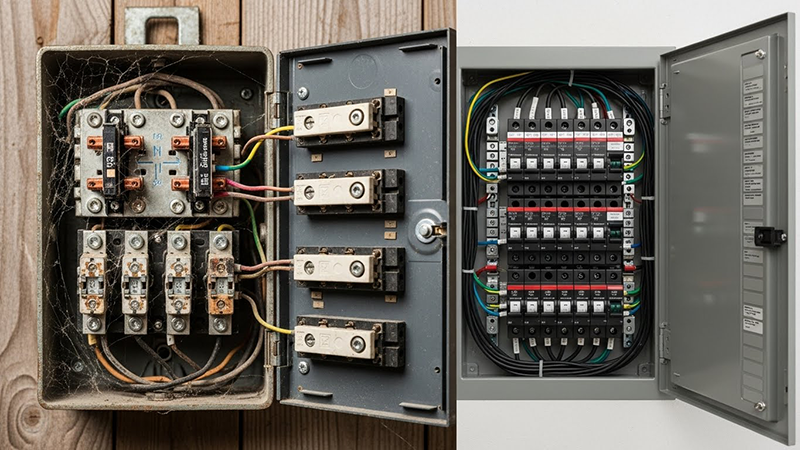
2. You’re Still Using a Fuse Box
If you have a fuse box instead of a breaker panel, your electrical system is decades overdue for replacement.
Fuse boxes were common in homes built before the 1960s, but they lack the safety features and capacity of modern circuit breaker panels. Fuses need to be replaced each time they blow, and many homeowners make the dangerous mistake of installing higher-amp fuses than the wiring can safely handle.
Signs you have a fuse box:
- Round screw-in fuses instead of flip switches
- You need to replace fuses when circuits overload
- Your panel has ceramic components
The bottom line: Fuse boxes can’t meet current electrical codes and don’t provide adequate protection for modern homes. An upgrade isn’t optional, it’s essential.
3. Your Lights Flicker or Dim Unexpectedly
Occasional flickering when you first turn on a major appliance is normal. But if your lights dim regularly or flicker without explanation, your panel is struggling to distribute power properly.
Common flickering scenarios:
- IF lights dim when your HVAC system kicks on, THEN your panel may not have adequate capacity for the load.
- IF lights flicker in multiple rooms simultaneously, THEN the issue is likely at the panel level, not individual circuits.
- IF you notice flickering along with buzzing sounds from the panel, THEN you may have loose connections or failing components, both serious safety concerns.
What causes this: An undersized or aging panel can’t maintain consistent voltage distribution. This damages sensitive electronics and signals potential wiring issues.
4. You’re Planning Major Electrical Additions
Adding high-demand appliances to an older electrical system without upgrading your panel is like trying to run a marathon without training, something’s going to give.
Common additions that require panel assessment:
- EV chargers: Level 2 chargers typically need a dedicated 240V, 40-50 amp circuit
- Hot tubs or pools: Require substantial dedicated power
- Central air conditioning: High startup and running amperage
- Home additions or basement finishing: More square footage means more circuits
- Workshop or garage equipment: Power tools and equipment draw significant loads
The calculation: Most homes built before 2000 have 100-amp or 125-amp service. Modern standards recommend 200-amp service to accommodate today’s electrical demands. If you’re adding major appliances and your panel is already at capacity, an upgrade isn’t optional, it’s required by code.
DO: Consult with a licensed electrician before purchasing major appliances or planning additions. They can assess whether your current panel can safely handle the additional load.
DON’T: Attempt to add circuits to an already-maxed-out panel. This creates dangerous overload conditions.
5. Your Panel Shows Physical Warning Signs
Sometimes your panel literally shows you it’s in trouble. Never ignore these physical warning signs.
Immediate concerns:
- Burning smell or scorch marks: This indicates arcing or overheating, shut off power at the main breaker and call an electrician immediately
- Panel feels warm to the touch: Panels should never be hot or even noticeably warm
- Rust or corrosion: Moisture damage compromises electrical safety
- Buzzing, crackling, or humming sounds: Indicates loose connections or failing breakers
- Visible damage or melted components: Evidence of past overheating or electrical faults
IF you notice any of these signs, THEN you should treat it as an urgent safety issue. Don’t wait for a convenient time, contact a licensed electrician right away.
What Happens During a Panel Upgrade?
If you’re experiencing any of these signs, a panel upgrade typically involves:
- Assessment: An electrician evaluates your current system and calculates your home’s electrical load
- Permitting: Required permits are pulled (any reputable electrician handles this)
- Installation: The old panel is safely disconnected and removed, and a new panel is installed
- Inspection: A licensed electrical inspector verifies the work meets code
- Timeline: Most residential upgrades take 4-8 hours
The investment: Panel upgrades typically cost between $2,500-$5,000 depending on amperage, location, and whether utility company service upgrades are needed.
Don’t Wait for an Emergency
Your electrical panel protects your home and family every single day. When it’s outdated or failing, you’re living with unnecessary risk, from fire hazards to damaged electronics to the inconvenience of constant power interruptions.
If you’ve noticed any of these five signs, it’s time for a professional assessment. At Taurus Electric, we provide free panel evaluations for Chilliwack homeowners. We’ll assess your current system, explain your options, and provide transparent pricing with no obligation.
Ready to upgrade your panel? Contact us through our website. Let’s make sure your home’s electrical system is safe, reliable, and ready for whatever you plug in next.